BEHIND THE BRAND: POWELL PERALTA
50 Years in the Garage, on the Wall, and Everywhere Between
We’ve chronicled the untold female history of Powell Peralta. This time around, George Powell takes us back to where it all began; a laid-off aerospace engineer, a garage, and a bet that skateboarding was worth staking a life on.
There are brands you skate on, and there are brands you grow up around without quite realising it. Powell-Peralta is the latter. Long before most of us were born, a guy who'd been laid off from an aerospace job packed up his life, moved to Santa Barbara, and started shaping decks out of urethane and fibreglass in what was, essentially, a garage operation. That guy was George Powell. Just a few years later, he teams up with a young skater named Stacy Peralta, and together they build something that would end up defining an entire era of the sport.
By ‘79 they'd accrued a ragtag group of teenagers with more talent than reputation, branded with a name that is still being tattooed on people to this day: the Bones Brigade. Tony Hawk, Steve Caballero, Rodney Mullen, Lance Mountain. Kids who'd go on to become the sport's biggest names, all riding for a brand that nearly folded twice before it found its feet. In 1980 and '81, at their lowest point, the crew were barely pushing out 500 decks a month. But by the time Stacy Peralta's 1987 film The Search for Animal Chin hit, the Brigade weren't just a skate team anymore. They were the closest thing skateboarding had to rock stars, and the company was now doing close to $30 million a year.
Of course, it didn't stay that simple. In 1991, Powell and Peralta went their separate ways. George kept building under the Powell name; Stacy went off and made Dogtown and Z-Boys, one of the most influential skate documentaries ever put to film. It took fifteen years, but in 2006 the two came back together as partners in Skate One Corp. A company that today still owns Powell-Peralta alongside Bones Bearings, BONES Wheels, Mini Logo, AERA, and RollerBones. The current team includes riders like Andy Anderson, Kelvin Hoefler, and Olympian Sakura Yosozumi. This isn't a brand running on nostalgia. The spirit of Powell-Peralta is very much active.
Hiding in Plain Sight
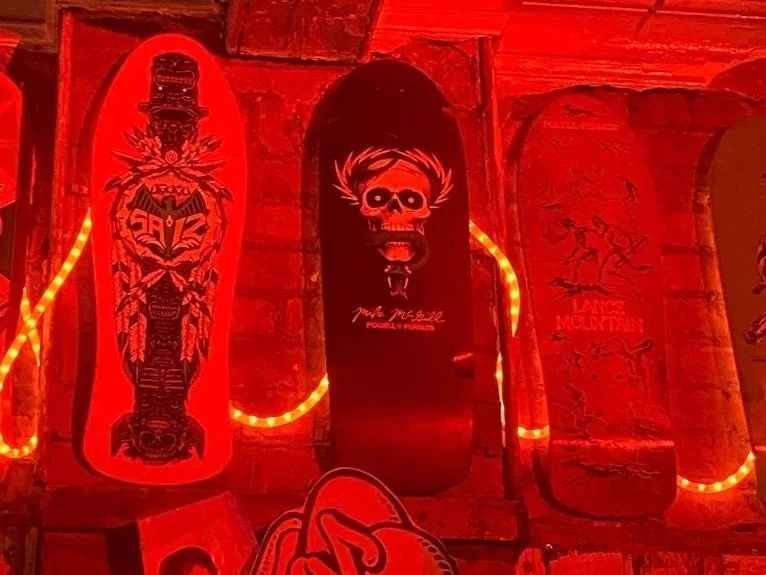
If you know where to look, Powell-Peralta is everywhere in the UK, and we’re not just talking shop shelves. Stickers turn up on bar toilet doors, wrapped around lamp posts near skate spots, scratched onto benches. I came across a skate-themed bar in Manchester recently with a few old Powell-Peralta decks hanging on the wall, sitting there as decoration, like they'd always been part of the furniture. It's the kind of thing you only really notice once you start looking for it, and actually says a lot about how deep this brand's roots actually go here in the UK, well beyond what shows up on a distributor's order sheet.
How It Reaches the UK
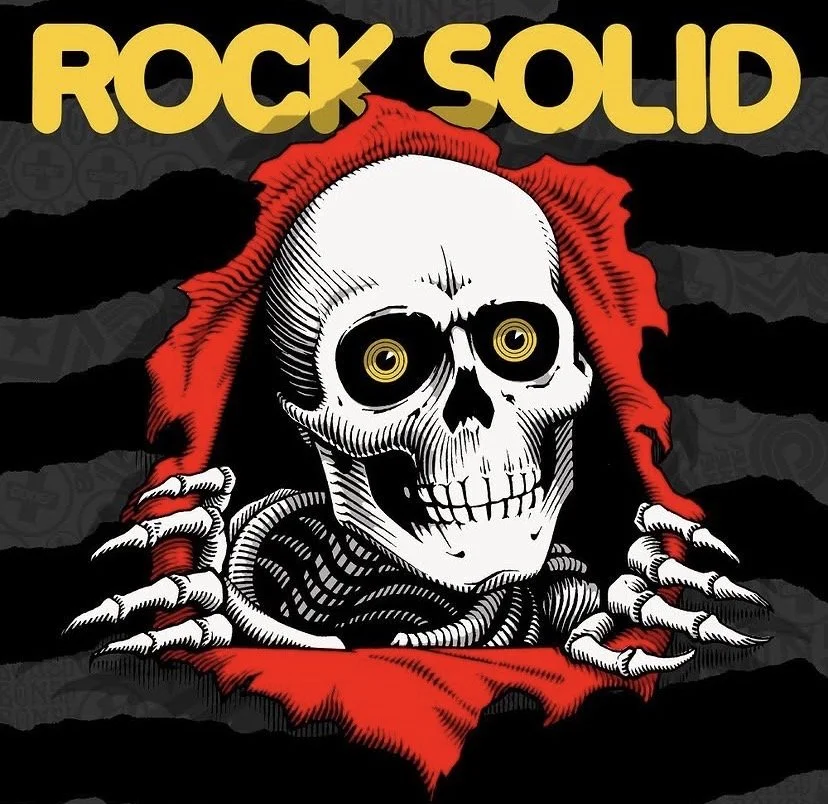
For UK riders, Powell-Peralta, Bones, and the rest of the Skate One family come through Rock Solid, a Bristol-based distributor who have been ushering in these products to UK shops all this time. It's a small world moment worth mentioning: when George first replied to us about this piece, he looped in Wes at Rock Solid directly, and it turned out we'd crossed paths before without ever properly meeting, at the Epicenter exhibition in Paris, and again at Rock Solid's own Open House event at Shredenhams. Wes and Ben, Rock Solid's Marketing Manager, have both been brilliant about this piece coming together, and Girl Skate Mag is already down to be part of their next Open House event.
In George's Own Words
What's been the hardest part of building Powell Peralta into what it is today?
"Haha! It's all been hard. For 50 years I've self-financed and operated a factory in California, USA. Manufacturing in the United States, especially in California, involves high costs and many regulatory hurdles. Add in periods of aggressive criticism and disparagement from competitors, along with the constant ups and downs of the skateboard industry, long-term growth has never come easily. It hasn't always been a smooth ride, but it's been an incredibly fulfilling one."
What's your proudest moment from the last 50 years?
"Still being in business after 50 years and still making the best equipment in the industry."
Is there a moment from the early days that still makes you laugh looking back?
"Most of my earliest memories are tied to a fear of failure. It may not be funny, but looking back, I genuinely believed that if I made better products than what was available, everyone would buy them. That assumption was incredibly naïve, and it still makes me laugh."
If you could go back and tell yourself one thing when you started out in your garage in the 70s, what would it be?
"Have faith and patience. This is going to be your life's work and you will learn a lot. It will be worth the journey."
What's changed the most about the skate industry from when you started to now?
"When I started in 1976, skateboarding was barely an industry. There were very few suppliers of the product, and little outside interest in investing in skateboard companies. Many believed skateboarding was a 'hula hoop' type of product, and the industry crash of 1980 indicated that was true.
Today, skateboarding has grown into a worldwide movement, attracting attention from venture capital firms looking to 'pump and dump' promising brands. In the beginning it was done for love, now it's sadly mostly about the money.
Even skaters now view skateboarding as a way to make a lot of money through sponsorships, brand deals, and Olympic success. However, those opportunities are extremely limited. And unlike traditional sports like football, baseball, or basketball, skateboarding does not generate enough money from competitions to support large numbers of highly paid athletes."
Everyone knows the Bones Brigade story, what's a part of Powell Peralta's history that you feel doesn't get talked about enough?
"Definitely our game-changing products that have enabled skating to advance since our start in the 70's. We've never stopped innovating, creating superior products, and maintaining exceptional quality standards. From revolutionizing polyurethane wheel formulas and shapes, protective deck accessories, truck bushings with bonded inserts, iconic art from VCJ, to our Flight Deck technology, and our newest Dragon Wheel Formula, I think we have more significant innovations than any other company in the industry."
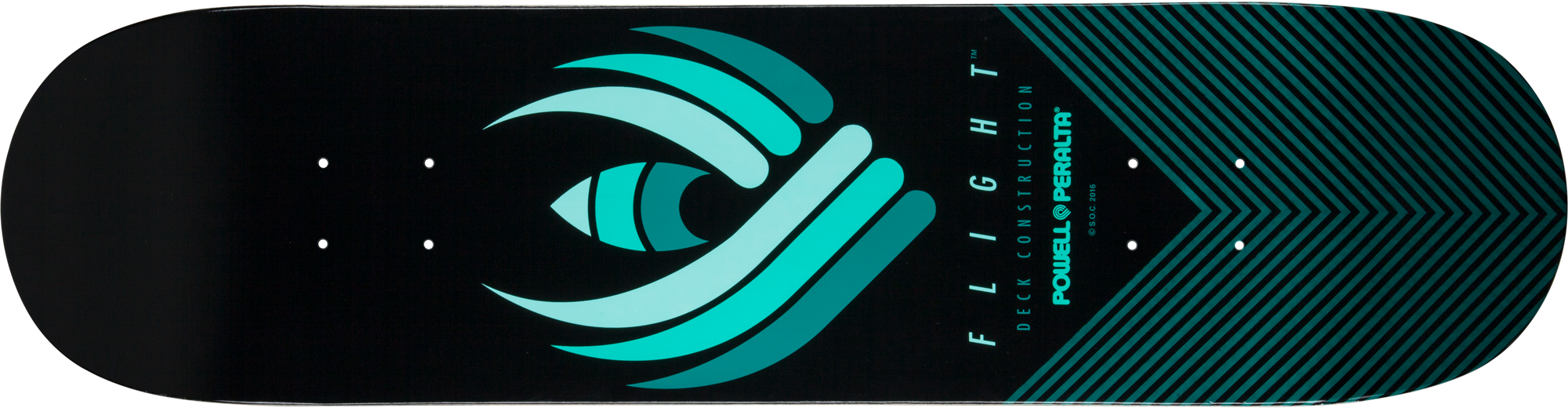
Image: First Flight Deck from 2016. Photo credit: Dana Sherlock
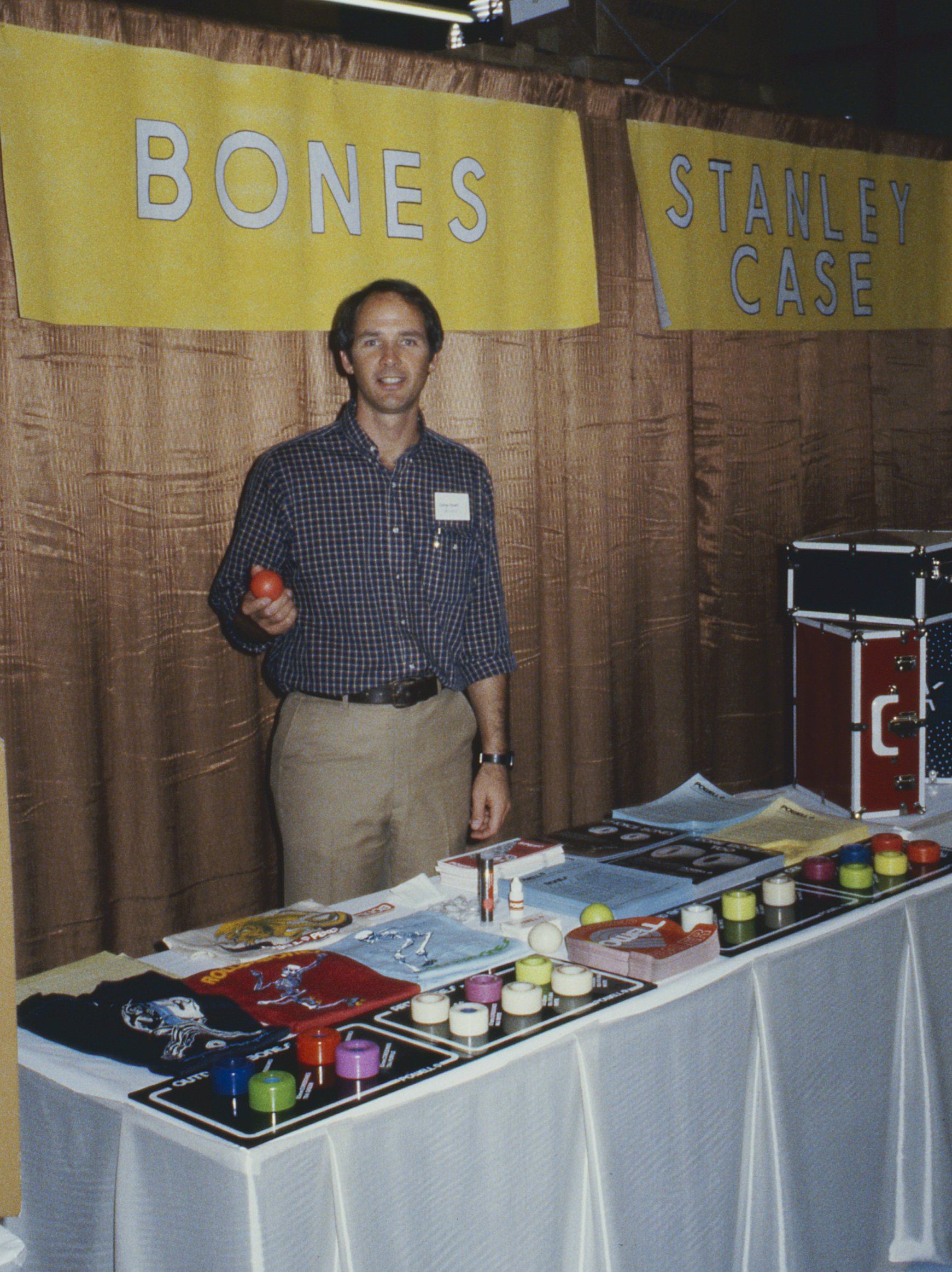
Image: George Powell at a 1981 Tradeshow. Photo credit: From the Powell Peralta Archives
What was it actually like during the lean years in the early 80s when the industry nearly collapsed, what kept the brand going?
"We survived because we were determined to, no matter what. I put my last savings into paying salaries, rent, and got a bank loan. We operated on a shoestring budget in a tiny facility, and our team got no salaries, just product. Stacy left to pursue work in Hollywood as an actor and tried to keep the team together when he had a spare moment. It was an act of love and desperation. I was determined to continue through what appeared to be the end of skateboarding's popularity because I believed in the fun and uniqueness of the sport."
Out of everything Skate One has built, Powell-Peralta, Bones Bearings, BONES Wheels, Mini Logo, AERA, RollerBones, is there one with the most interesting or unexpected history?
"There are two that were created by demand, unexpectedly: Bones Bearings and RollerBones. When skating declined in 1980 the popular 'German' bearings stopped being made available to the skate industry. So, I went looking for a high-quality bearing to offer skaters, because only mediocre Japanese bearings were available, and they were not optimized for skating. I found a small OEM bearing factory in Switzerland and got them to allow me to change the specification in order to optimize Bones Swiss for skating, and still be top quality. With no competition at the time, Bones Bearings unexpectedly took off.
RollerBones was created when roller skaters approached us to ask if we would pour our successful Bones Skateboard wheel formula in roller skater size wheels for them, because it was so much better than the existing urethane wheels. This is funny and ironic because those slow, fork-lift formula urethane wheels were what revolutionized skateboarding in 1974, but by 1979, roller skaters were coming to us to get the best urethane wheels. RollerBones sold themselves by being clearly better."
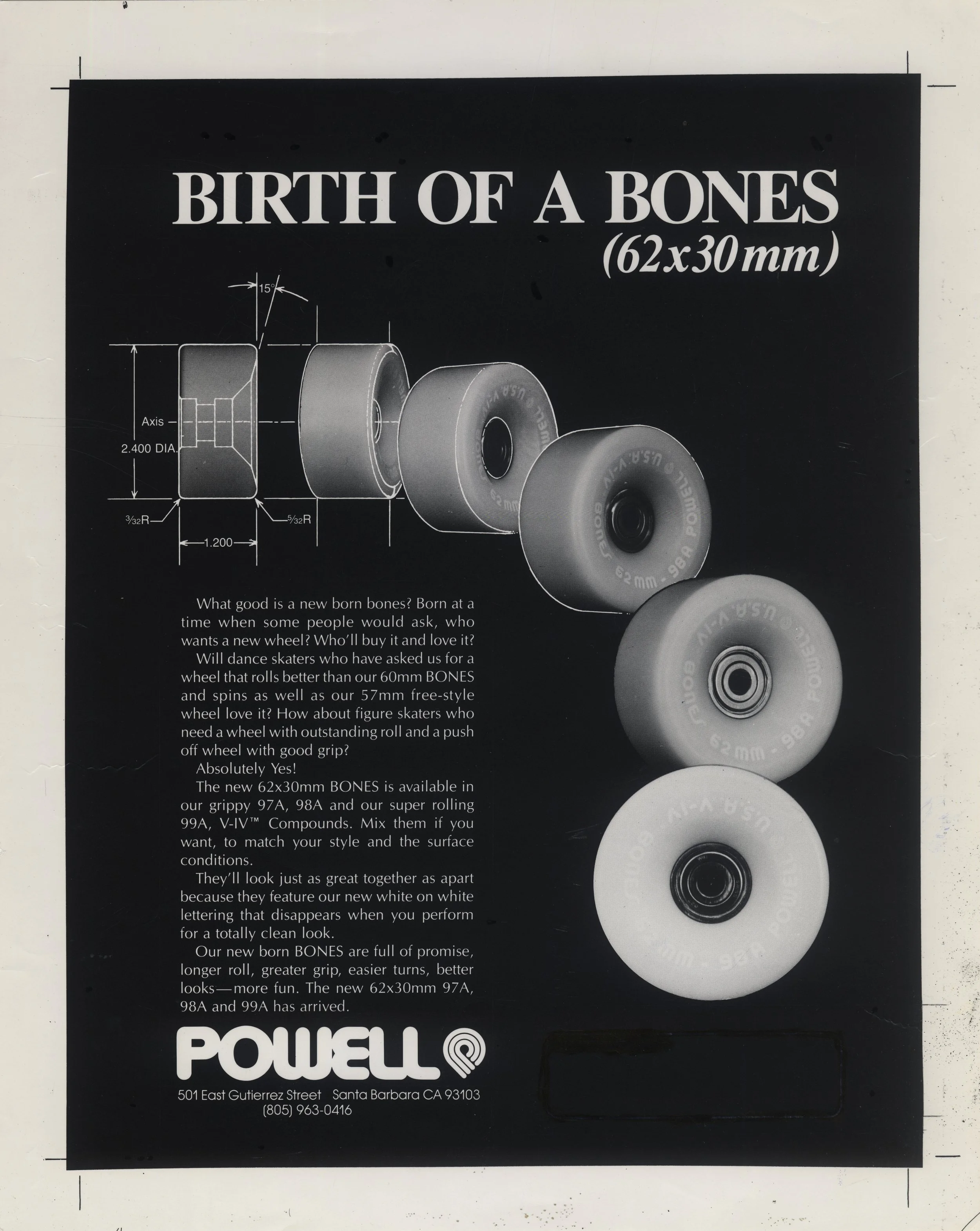
Image: Birth of a Bones Advertisement, 1977. Photo credit: From the Powell Peralta Archives
How has the identity of the brand evolved since the 1978 founding, while still staying recognisably "Powell Peralta"?
"In 1978, Stacy joined me to create a strong skateboard team at a time when the skateboard industry was tiny. Thanks to his reputation and influence, he was able to recruit some of the best young unsponsored skaters to our team. Together, we focused on marketing that team, which would later become known as the Bones Brigade in the 1980s.
Today, our team is known simply as the Powell Peralta Team, out of respect for how special the 1980's BB of Tony, Mike, Tommy, Lance, Rodney and Steve was. The industry of today does not allow a small band of skaters to dominate world competitions like was possible in the 1980's. As a result, our current focus is simple: skating for fun, and creating the industry's best products.
Over the years, two things have played a major role in keeping the Powell Peralta brand strong. The first is the enduring legacy of the Bones Brigade. The second is the artwork of V.C. Johnson (VCJ), whose iconic graphics have become inseparable from the brand. Remarkably, VCJ continues to create new artwork for us today, providing nearly 50 years of visual continuity, a rare distinction that few brands in the skateboard industry can claim."
How do you choose who's on the Bones Brigade, what are you looking for in a rider beyond just skill?
"A positive attitude, a dedication to skating, communication skills, self-promotion skills, the ability to get along with and help fellow team members, and loyalty to our company."
Has the way you pick riders changed over the decades, or has the philosophy stayed the same?
"It has largely stayed the same, but because skating is so much more diverse, we also look for a slightly broader skillset than before. We don't just look for skaters who are specialized in vert, street, ramp, pool, ditch, park, or downhill, we look for skaters who can and do 'skate anything and everything.'"
Is there anything about the brand's story you feel we haven't asked about but should?
"What separates Skate One from all the other companies offering products to skaters? We believe it is our responsibility to support as many of skateboarding's terrains and styles as we can with products optimized for each, to promote skateboarding to people around the world, and to actively work to portray it as a fun, creative, positive activity that can be enjoyed anywhere, by anyone, in any way that rewards the skater. Skateboarding is our life and life's work, as proven by 50 years of helping skaters along their paths to successful careers, creating game-changing products, and helping to grow skateboarding. We believe this makes us worthy of skaters' support, so that we can continue to help move skateboarding forward."
Closing
The Bones Brigade made Powell Peralta famous, but talk to George long enough and it's clear the brand was never just about six kids in the 80s. It was always about all those that would follow after them. That's the actual legacy here, not the logo, the continuity, and the fact that it was all built for the love of skating. The inspiration was the brand goal long before it ever had anything to do with money.
Missed Part 1? Go back here and read about the women who've shaped this brand for over fifty years, most of it never told publicly until now, published here on GSM as of August 14th 2026. Tune in next month for the next Behind the Brand, and if you want to learn more about the world of skating, check out the rest of our blog and magazine.