Meet Baltic Dew: Giving Old Boards a Second Life
Written by Girl Skate Mag
There's something quietly magical about picking up a skateboard for the first time at 40. About finding a community, falling in love with it, and then asking yourself: how do I stay connected to this thing even when I'm not on it? For Rasa, aka Baltic Dew, the answer came through a rotary tool, a pile of broken decks, and a whole lot of YouTube videos.
We sat down with her to talk jewellery, wood, amber, and why imperfection is actually the whole point.
First things first, where does the name Baltic Dew come from?
"Baltic is from my roots. I'm from Lithuania, which is a Baltic State, by the Baltic Sea. And Dew is actually my name, but it's a traditional Lithuanian name that means morning dew. So that's how Baltic Dew came across."
She's wearing a few bracelets with a single amber bead as we talk. It turns out amber runs through her work in more ways than one. A friend back in Lithuania sends her pieces of it, and she weaves them into her jewellery. "Amber has like 20 shades or something," she says. "This one is black amber, and this is yellow amber." She gestures to her wrist. There's a quiet pride in it, a piece of home, carried with her.
So how did a Lithuanian woman living in the Midlands end up making jewellery from skateboards?
It started, as so many good things do, with a gift.
"I never skateboarded before I turned 40. My friend knew I was interested in it and sent me a Birdhouse deck. He told me what wheels to get, what bearings, big soft wheels, and sent me a truck too. I grabbed everything, went to 42 in Nottingham, they put it all together, recommended me to go to Flow, and I just… met so many friends there."
She pauses, smiling. "I fell in love. And then I wanted something more. I kept thinking, how can I stay connected to this?"
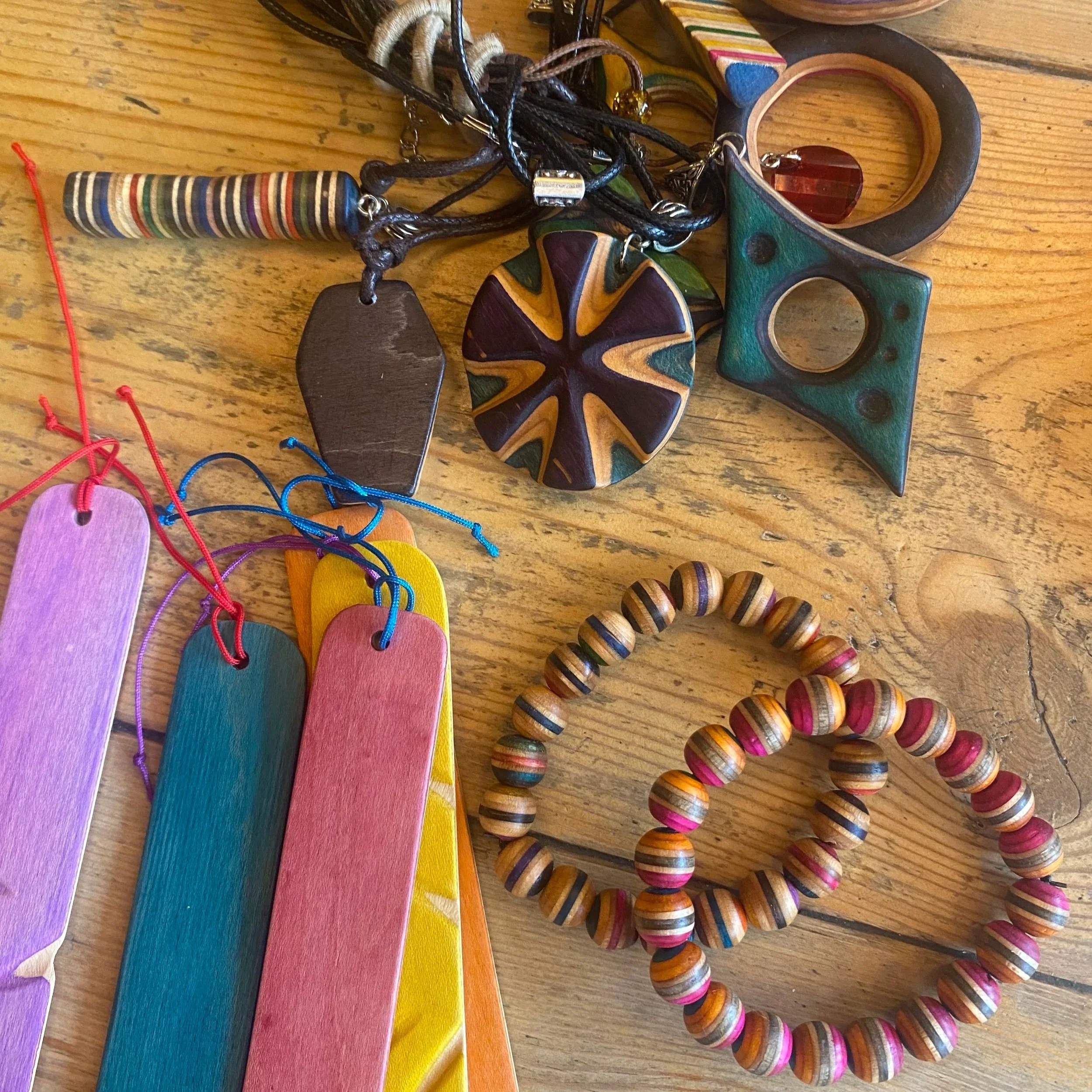
The answer came through another friend, whose boyfriend had started making furniture and wall art from old skateboard tails. She asked him for a couple of off-cuts. "I found a YouTube video showing how to make a pattern, found an old rotary tool at home. It made me anxious at first. And then I started sanding it, and all these layers started to show. I was like, oh my god, this is so cool."
Her first pieces mixed skateboard wood with Swarovski beads as she was deep into beading at the time. But gradually, the wood took over. Then a friend invited her to a maker space, where she discovered power tools. She never really left.
"My dad made a comment like, 'I never thought my daughter would become a carpenter,'" she laughs."
What's the most challenging part of working with recycled boards?
"Oh, there are a lot of challenging things," she says, but she's grinning. "The most exciting thing is actually getting the boards, and sometimes the challenging thing is the board itself. You have to fight with the wood. Old skateboards are made from maple, but the quality can be different. The grip tape, sometimes it comes off easily, sometimes it just sticks."
She used to use a heat gun to remove grip tape, but even that doesn't always work. Sometimes the glue is so deeply embedded the wood just won't cooperate. "Sometimes the wood doesn't want to work with you at all. You cut it and it just keeps breaking." She shrugs. "But I think that challenge is actually really interesting. It just makes you want to do it more."
Tell us about the layers, because that's such a big part of what makes these pieces special.
A standard skateboard deck is made from seven layers of maple, and those layers are where all the colour lives. Some boards are only colourful on the top and bottom. Others have every second layer dyed in a different shade. When you cut and sand into them, you never quite know what you're going to find.
"When I get a new board, from skaters, skate shops, indoor parks, wherever, I always ask if they have any broken boards. If I'm visiting a new skate park, I'm going to ask. If I'm going to a skate shop, I'm going to ask." She's been to Ideal Skate Shop in Birmingham, where her boyfriend lives. "My car is full of skateboards. My living room is full of skateboards, wood tools, sandpapers, everything, everywhere."
When a new board arrives, the first thing she usually makes is a ring. "On a ring, you see the colours pop the most. Especially when you use resin glue, and then shine and polish it, that's when you see really vivid colours."
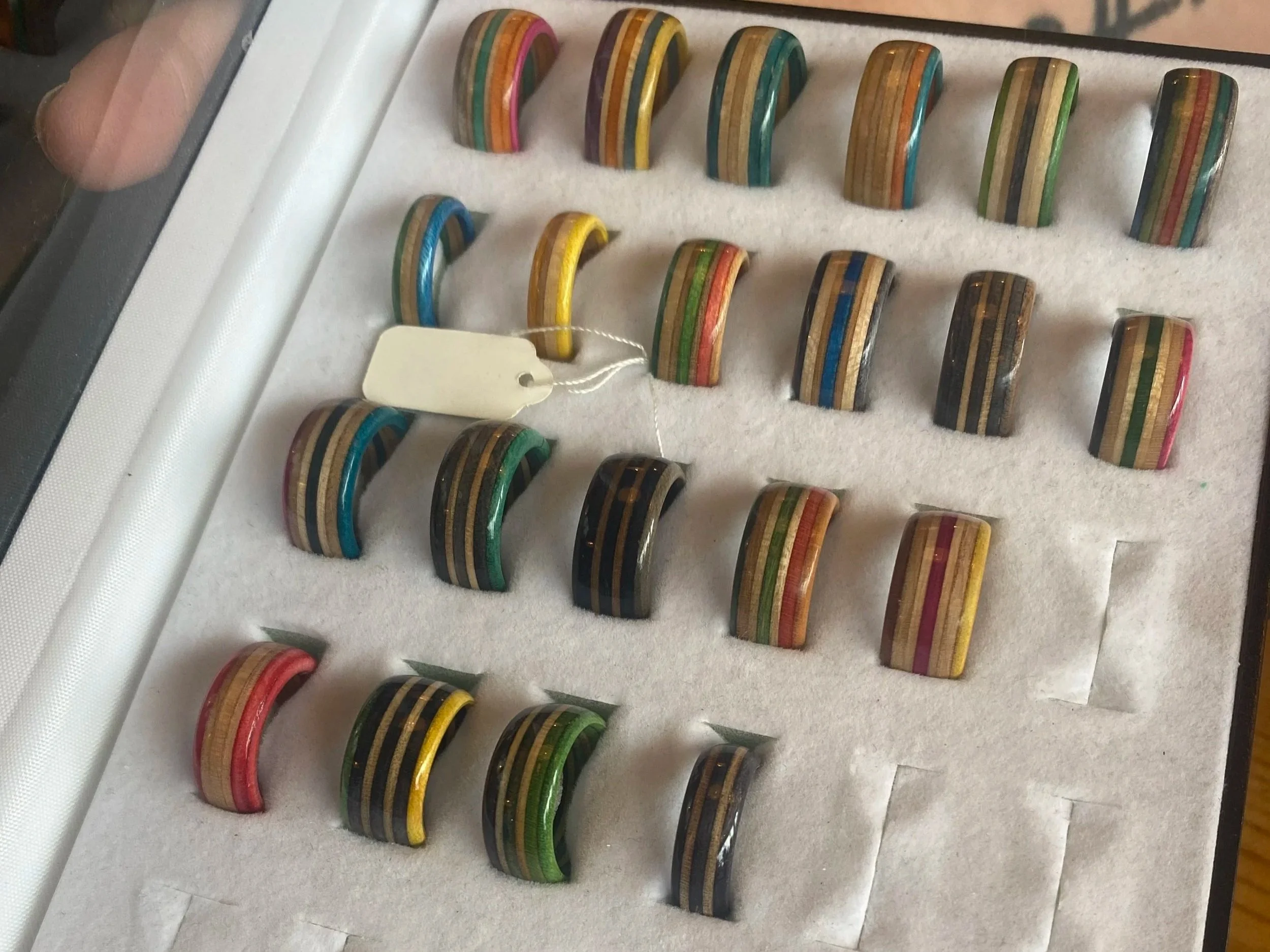
The beads and bracelets sound like a whole process in themselves.
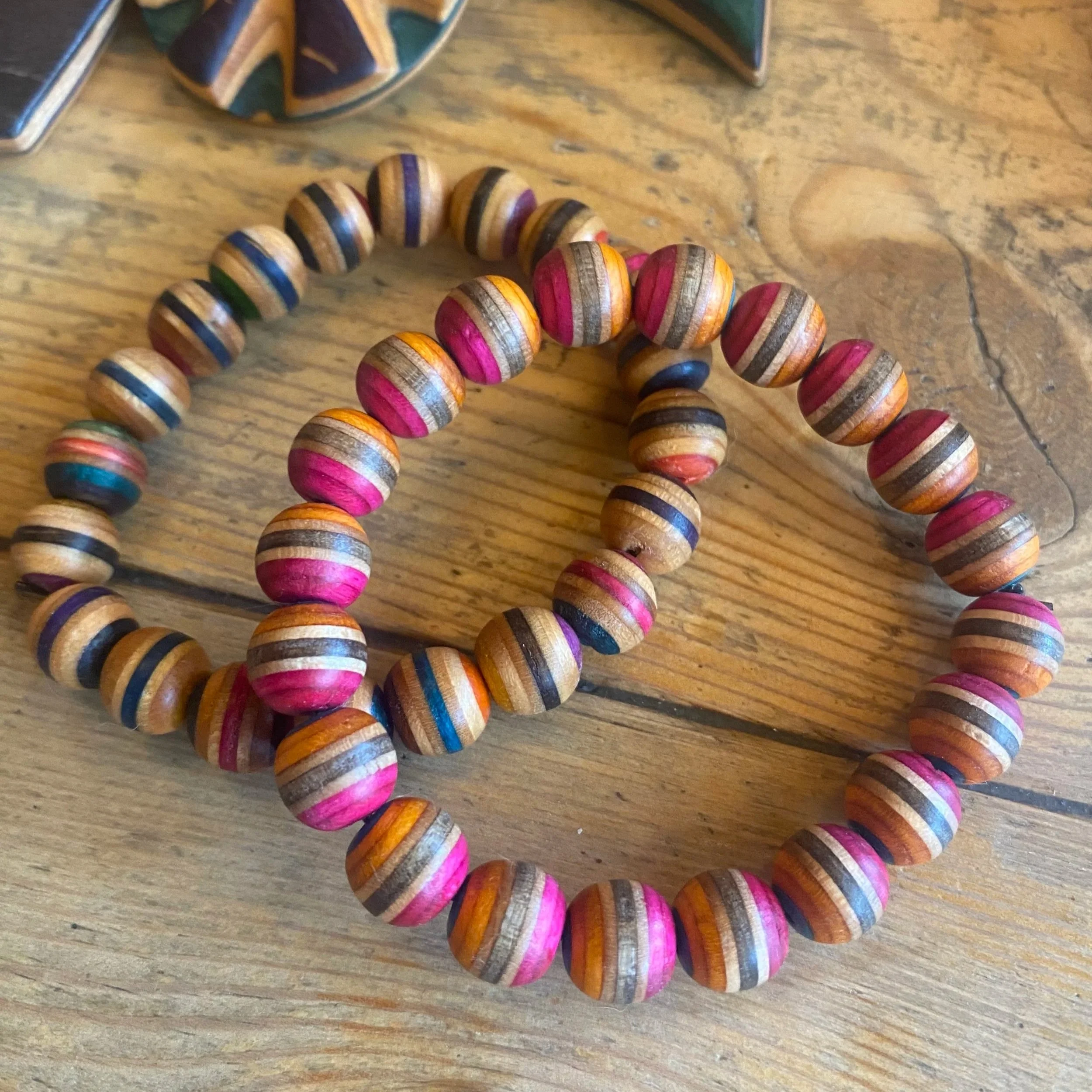
They really are. She walks us through it: remove the grip tape, sand top and bottom, cut into pieces, drill the bead shape using a special drill attachment, sand again through multiple grits, coat, rest, recoat.
"The beads are not always perfectly round, one side might be flatter than another. I used to get really frustrated about that." She smiles at the memory. "But then someone at the workshop said, 'Rasa, can you see from this distance that it's not perfectly round?' And I looked, and I couldn't. He said, sometimes imperfect makes it perfect. It gives you the feeling that someone actually invested the time and made it."
She figured out almost everything herself, through asking questions, watching YouTube, following woodworking channels on Instagram. "I don't have formal woodworking skills at all. It's all self-taught."
You've got a top seller online that might surprise people...
Earplugs. Wooden earplugs, made from skateboard decks.
"I have really good comments about them. People say they're so light to wear." She's had a lot of orders from America. "They're quite a sensitive piece of jewellery as they go inside your skin, so I only finish them with a natural oil. I sand really, really well to remove everything. And people love them, especially people who wear the larger sizes, because they say it's hard to find ones that are comfortable."
Custom orders are a big part of it too. People contact her, tell her what colours they like, and she works with what she has. "I get excited myself, trying to find the right board for them."
You also teach skating. Tell us about that.
Alongside the jewellery, Rasa has joined Skate Nottingham and teaches beginner sessions for kids and adults during the summer months mostly, and whenever she can the rest of the year.
"I really like teaching beginners. Because the joy you see in someone's eyes in that first hour of skateboarding, when they start thinking they can't do it, and then after an hour they're like, oh, I can push, I can actually be on a skateboard, that joy, you never see it in quite the same way later. You see joy when someone learns new tricks, but it's different. That first joy is something else."
What do you enjoy most about the whole process?
"The process itself. Figuring out how to make something new." She doesn't hesitate. "I see how other people do things, I try to figure it out myself, I ask fellow woodworkers, and sometimes it's just trial and error, trial and error, trial and error."
There have been frustrating days. But she has a couple of close friends who've been with her since the very beginning, who remind her how far she's come. "They'd say, remember when you were making rings, and you said ten of them were failures? And now look." Someone recently called her an expert. She laughed it off, but then she thought about her very first rings, the ones some of her earliest customers still wear.
"I look at them now and I'm like, oh my god, how can you still wear that, it looks so terrible to me. But they say, 'No, no, I really like it.' And I tell them, I will make you a new one! And they say, 'No, I like this one.'" She shakes her head, delighted by it. "And it's still not broken. After a year and a half."
Quality sounds like something you feel really strongly about.
Deeply. She spends a long time on each piece, longer than she probably needs to, she admits, because she wants the jewellery to last. "Wood wears off, nothing is forever. But I want to preserve the colours. I want the shape to stay as long as possible. That's why I keep trying different coatings, different products." Every piece comes with care instructions too, how to look after it, what to avoid, how to keep the wood from drying out.
"I invest a lot of time in quality because when people get my jewellery, I want them to wear it for as long as they can."
What does the future look like for Baltic Dew?
"I would love for it to be my full-time job at some point."
For now, ideas keep coming faster than she can make them. She has a mental waiting list of things she wants to try, techniques she wants to figure out, shapes she hasn't attempted yet. She sells at markets but has to hold herself back, resist putting everything out at once, keep some things back, not overwhelm herself with stock.
"I just love the process of putting something new together, making something. And it's always coming. I have so many ideas in my head, I just don't have enough time."
And the best moment of all? Seeing someone wearing her work months after they bought it.
"That means I did my job."
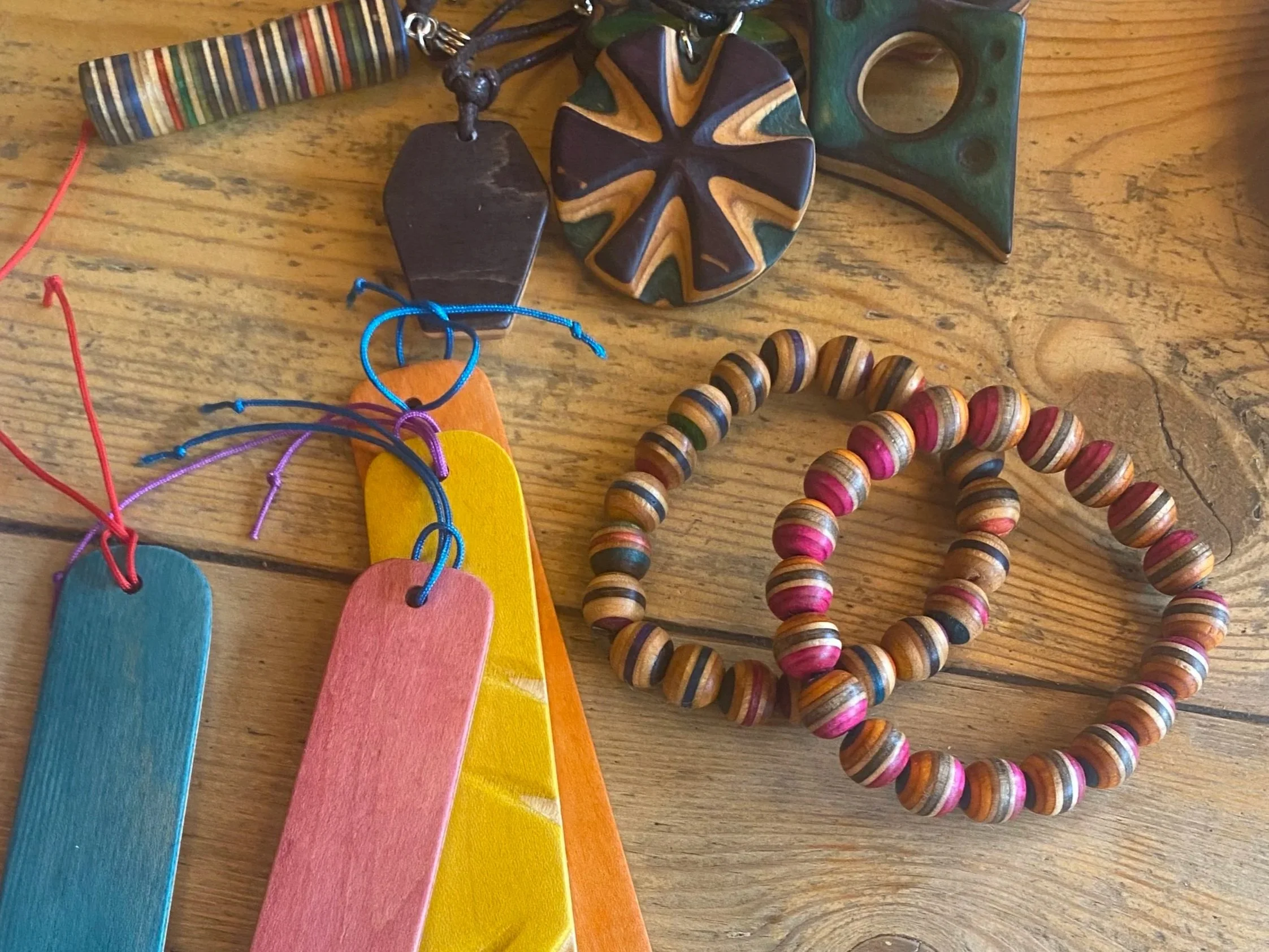
There's a thread running through everything Baltic Dew makes, the amber from Lithuania, the grip tape she wrestles off old decks, the bearings salvaged from worn-out wheels. It's all about giving things a second life.
"These boards come from the streets, end up in my workshop, and then go to people who want to wear them. And it's not necessarily skaters. It's people who appreciate individuality, who like colour, who like to be a little bit different, who like handmade things. Anyone can wear it." She pauses. "You don't have to be a skater. You really don't have to be a skater."
Find Baltic Dew's jewellery online and follow her work on social media. If you've got a broken deck and you're based near Nottingham or Birmingham, you know who to call.