Platza
By Berrit Schindler
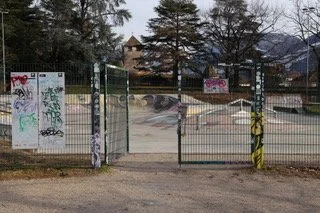
I lock my bike to the designated stands in front of the green fence and walk along the small gravel path toward the entrance. Small pebbles crunch sporadically under my shoes as I step onto the smooth concrete of the park. As I walk through the open gate, the only way to enter the park, I notice once again the high fence surrounding it. Ironically, although it is actually the only open part of the fence, this is where it strikes me the most. It is clear that I am following the given architecture here, because to get to the park entrance, I have to walk almost halfway around the park.
I look left and right first and then walk towards the small picnic bench that stands in the shade of the trees at the edge of the “Platza” – the name of our small skatepark here in Bolzano. From there, you can see the whole park. I put my things down and watch the other skaters.
To my right, someone rides off a ramp and skillfully jumps onto the small railing in front of me. From there, they continue straight ahead, down a small curb and then back up the steepest ramp in the park. Another skater is just starting from this ramp. He races past the small entrance gate and jumps onto the small concrete elevation opposite the ramp. The wheels of the board glide almost silently over the smooth concrete of the skate park. I take my board and go up a steep ramp in the back quarter of the park. In front of me, about 3.5 meters deep, lies the only bowl in northern Italy. Despite the abundance of graffiti, it still resembles an empty swimming pool. Graffiti adorns the entire park. There are hardly any surfaces left without drawings or tags. The park, which was completely new and polished in 2013, has become a veritable art collection over the past 12 years. The graffiti and skateboarding communities are closely intertwined. This makes sense insofar as both groups define themselves strongly through the themes of self-determination, expression, and individualism, but also through breaking rules and a certain distancing from the rest of society.
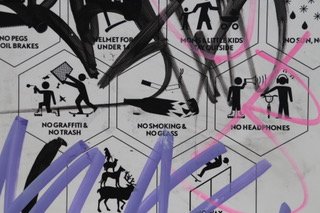
On the other side of the bowl sit the same skaters as every day. They meet here to smoke and drink together—which is actually prohibited—and, of course, to skate. People here seem reluctant to be told what to do. The community has appropriated the park to such an extent that, despite the fence around it, it feels like you are entering a closed space when you enter the park.
The mainly male skate community usually occupies the same spot on weekdays, mostly in the evenings. This makes me observe more closely. In the last eight months, I can remember seeing about five to six female skaters. Two of them more than three times. However, women are not only underrepresented among skaters. The children who fill the park with scooters and bicycles on weekends are also mainly boys. Skating brings together a wide range of age groups. A father skates barefoot on a borrowed board before continuing his walk with the stroller. It becomes clear to me that skating is more than just a hobby. It is a way of life that you take with you when you leave the park. The skaters act almost like they are a family. The interaction between people is mostly very open and friendly. Tolerance and open-mindedness are also strongly felt values. Even unknown skaters are greeted like good friends – community through skating. Something that only exists in the very unique world of skating.
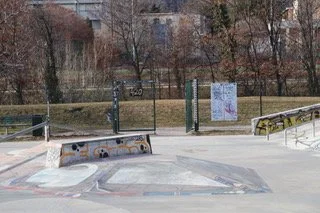
The separation between the outside world and the skating world is barely noticeable and yet unmistakable. The atmosphere of unwritten rules and a close-knit community hangs like an invisible blanket over the park, which is actually accessible to everyone.